

Dr. Steven G. Driese Outstanding Grant Proposal Award
In 2006, Dr. Steve Driese identified a need that prompted him to create the course GEO 5222 Grant Proposal Writing. In the years that followed, the course provided students in Geoscience and other STEM disciplines with didactic and practical training in writing grant proposals. By the end of the class, students have drafted a research grant proposal, typically in NSF style, and the Geoscience Department began a tradition of awarding $500 to the student who produced the best proposal from each section of the course.
In the Fall 2021 semester, the Graduate School joined in this effort by committing to share in future costs of the award, and, to honor Dr. Driese upon his retirement from Baylor and from his position as Graduate School Associate Dean for Research, the class award was renamed the Dr. Steven G. Driese Outstanding Grant Proposal Award.

Dr. Bill Hockaday co-taught with Dr. Driese beginning in 2016 and upon Dr Driese's retirement assumed full responsibility for GEO 5222.
Starting in 2026, the award expanded to select the best proposal from among 13 graduate grant writing courses across multiple departments and disciplines, with a rigorous rubric that examines scholarship & technical plan, intellectual merit, feasibility & approach, impact/significance, and communication & presentation.
The 2026 award winner is:
Evan Mastin for his proposal "Toward Label‑Free, Nano‑Precise Cancer Detection by Integrating Multimodal Near‑Field Nanoscale Vibrational Probes" from Spring 2026 CHE 5260 Scientific Communication taught by Dr. Darrin Bellert.
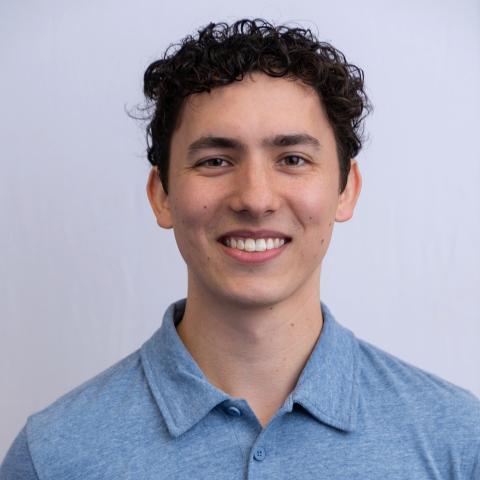
Evan Mastin joined Baylor University in the fall of 2017 as an undergraduate Science Research Fellow concentrating in chemistry, and he additionally earned minors in mathematics and physics. Evan conducted three years of undergraduate research in Prof. Darrin Bellert’s Lab focused on fundamental physical chemistry of small molecule decomposition kinetics, resulting in two publications. Following his undergraduate degree, Evan matriculated into Caltech’s Department of Chemistry and Chemical Engineering graduate program, where he joined Prof. Geoffrey Blake’s Lab. Evan’s work there focused on characterizing small molecule clusters of water and alcohols via microwave spectroscopy, resulting in an additional two publications and a M.S. in physical chemistry. Following his Master’s, Evan transitioned into simultaneous positions working in a biospecimen testing lab while teaching undergraduate chemistry at Dallas College. In the fall of 2025, Evan entered Baylor’s Department of Chemistry and Biochemistry graduate program to pursue a Ph.D. and subsequently joined Prof. Jonathan Larson’s Lab. He is now actively working on developing and implementing cross-cutting analytical tools (based in nanoscale vibrational spectroscopy) for non-destructive and label-free characterization of biological samples with relevancy to basic biochemistry and a diverse set of applications, including pharmacology, pathology, and oncology.
Past Winners:
2024
Patrick Bailey from the Department of Biology for his GEO 5222 research proposal “Back to the Sea: A Comparative Assessment of Gray Wolf Aquatic Habitat Use” with mentor Dr. Sarah Keinle.
Spring 2023
Alyssa Mills, PhD Student, Geosciences, for her GEO 5222 research proposal entitled "Piecing Together the Chaos Puzzle: An Evaluation of Seafloor Volcanism on Europa through Gravity Analyses" with mentor Dr. Peter James.
Fall 2022
During the 2022-2023 academic year, the class moved from the Fall to the Spring Semester, so there were no Fall 2022 awards.
Fall 2021
Alix Fournier, PhD Student, Geosciences, for her GEO 5222 research proposal entitled “Interrelation between late Quaternary geomorphic and hydrologic processes for the evolution of Monahans and Kermit dune fields, West Texas, USA," with Dr. Steve Forman in Geosciences as Ph.D. advisor.
Ariel Leahy, PhD Student, Biology, for her GEO 5222 research proposal entitled “Pinnipeds as Models for Underwater Vehicles: The Anatomy and Biomechanics Behind Aquatic Maneuverability,” with Dr. Sarah Kienle in Biology as Ph.D. advisor.